And then they continue to believe that it’s true to this day and thus it’s okay to genocide people and seize land because the god they made up promised the land they wanted to them.
The worse is that this story was written not to be taken literally. I mean, the pharaoh’s name is “Pharaoh”… it’s clearly a tale, and was from the beginning.
tbf, referring to divine monarchs only by their title is not uncommon. Many Egyptian texts referencing the Pharaoh of a given period only refer to him as ‘Pharaoh’. Hell, the Japanese Emperor traditionally does not go by any name until after he is deceased.
Even many texts written outside of a Roman cultural milieu refer to the Emperor only as ‘Caesar’ without mentioning the Emperor’s actual name.
Yes, but this text was not written in Egypt. In Israel and Judah, were the tale was written, the king is always named, between other causes because the principle of the divine monarchy is heavily criticized. But there are other problems with names, like the name of the parted sea (the Yam Suph is not the Red Sea), which would clearly put the story in a fantastical setting for a subject of Israel and Judah. And the structures and events are topos of ancient near east mythology (the reluctant leader, for example). Ancient people did not believed in their myths in the modern sense of the word, as Paul Veyne proved with the Greeks. It was the same for the Hebrews.
Yes, but this text was not written in Egypt. In Israel and Judah, were the tale was written, the king is always named, between other causes because the principle of the divine monarchy is heavily criticized.
The New Testament only refers to the reigning Emperor as Caesar - is this because the notion of a divine monarchy is now accepted in Jewish-Christian culture of the 1st century AD?
But there are other problems with names, like the name of the parted sea (the Yam Suph is not the Red Sea), which would clearly put the story in a fantastical setting for a subject of Israel and Judah.
Aren’t there a number of actual locations that are regarded as fitting the Yam Suph?
Ancient people did not believed in their myths in the modern sense of the word, as Paul Veyne proved with the Greeks. It was the same for the Hebrews.
I feel like that’s a dangerous level of cross-cultural equivocation, especially considering the vast differences in both philosophical and religious attitudes between the two peoples. You never see Temple or Rabbinical Judaism, for example, discussing the possibility of changing the founding mythology of their faith the way that Greeks openly did.
The New Testament only refers to the reigning Emperor as Caesar - is this because the notion of a divine monarchy is now accepted in Jewish-Christian culture of the 1st century AD?
No, there is at least two named emperors, August (Luke 2:1) and Tiberius (Luke 3:1). Most of the usages of Caesar in the New Testament is about the function, not an Emperor in particular.
Aren’t there a number of actual locations that are regarded as fitting the Yam Suph?
Quite a few, but none is clear. It’s not a particular location, not one knew by the people of the time.
You never see Temple or Rabbinical Judaism, for example, discussing the possibility of changing the founding mythology of their faith the way that Greeks openly did.
No, but we see the result of these changes. Just look at Genesis 1 and Genesis 2; the first one clearly is a rewriting of the second. Or both books of Chronicles, which are rewritings of the books ot the Kings.
No, there is at least two named emperors, August (Luke 2:1) and Tiberius (Luke 3:1).
You’re right about that, I concede that point. It’s been a long time since I’ve read the New Testament.
Most of the usages of Caesar in the New Testament is about the function, not an Emperor in particular.
Do you think most provincials and Hellenized citizens of the East would have made that distinction clearly?
Quite a few, but none is clear. It’s not a particular location, not one knew by the people of the time.
How can it be asserted to not be a particular location if there are several possible locations that fit?
We don’t know where the Rubicon River was, yet it’s certain that it was a particular location.
No, but we see the result of these changes. Just look at Genesis 1 and Genesis 2; the first one clearly is a rewriting of the second. Or both books of Chronicles, which are rewritings of the books ot the Kings.
Results are very different from proposals. I can remake all the myths I want simply by retelling them in the way that I desire without further comment; but proposing to do so can lead to very different reactions according to culture and context. Proposing to rewrite a myth necessitates either supremacy of human needs or perceptions over the myth - something which was controversial but not unthinkable for Greeks, but near-unthinkable for Judaism and subsequent Abrahamic religions.
Do you think most provincials and Hellenized citizens of the East would have made that distinction clearly?
The distinction between a function and someone occupying it is not one hard to make.
How can it be asserted to not be a particular location if there are several possible locations that fit?
Because when authors wanted to be precise, they can. If they don’t, it’s a choice. Millenia after, religious archeologists who read this text literally looked for the place, and the fact that they did not found one and disagree is more telling than anything else.
near-unthinkable for Judaism
The fact that they did not keep tracks of their discussions doesn’t mean they did not occur. And the extent of the biblical rewriting, with discernable schools like the deuteronomist one, is the proof that this rewriting was conscious, organized and debated. We also have signs of this kind of work in Qumran. You seem to see Judaism as an ahistorical reality; the truth is that it evolved a lot; rewriting propositions were common until at least the fall of Jerusalem in 71. And after that, this work continued differently in the Midrashim, without changing the text but changing its interpretation extensively, with comparable results as the rewriting of the text.
The distinction between a function and someone occupying it is not one hard to make.
That’s a very fucking modernist point of view.
Because when authors wanted to be precise, they can. If they don’t, it’s a choice.
what.
Do you… do you think they were going to give a coordinate grid reference if they wanted to be precise?
Do you have any idea how many place names are incredibly generic, and only have any manner of uniqueness because of the adoption of the practice of not translating foreign toponyms? Itself a very recent development in most languages?
They gave the name of what they called the place. How much more precision are you looking for?
Millenia after, religious archeologists who read this text literally looked for the place, and the fact that they did not found one and disagree is more telling than anything else.
… you literally already conceded that there are several places that fit the description by archeologists’ estimates.
The fact that they did not keep tracks of their discussions doesn’t mean they did not occur.
“You can’t prove that they didn’t” isn’t very fucking compelling from an academic standpoint, especially when the argument presupposes the existence of the discussions to begin with.
And the extent of the biblical rewriting, with discernable schools like the deuteronomist one, is the proof that this rewriting was conscious, organized and debated.
How does that follow at all?
You seem to see Judaism as an ahistorical reality;
… what is that even supposed to mean?
the truth is that it evolved a lot; rewriting propositions were common until at least the fall of Jerusalem in 71.
…
And after that, this work continued differently in the Midrashim, without changing the text but changing its interpretation extensively, with comparable results as the rewriting of the text.
Changing interpretations and changing the text are so fucking distant from each other in an Abrahamic religious context that it’s bizarre that you even bring it up.
Thank you for the reference to Paul Veyne. I’ve been reading quite a lot of history, most recently a summary of Egyptian history and I might have to skim Veynes work.
Veyne is great. I don’t know how his work is treated by nowadays historians, but it was a revelation for me. My passion is more medieval history, but we find the same kind of things: just read medieval bestiaries, you’ll find a lot of unbelievable things about very common animals like rabbits. People who wrote that knew that they were not real things, but they still thought that they were true. We lost a lot when we begun to think that real = true. It was the same things for mythologies, and biblical ones too: people knew they weren’t real things of the past, but they were true things of their present.
It’s more complicated than that of course (there are more than just two “modes of truth” to use Veyne’s terminology), and I’m sure most people believed that Moses actually existed (he probably didn’t). Moreover, an intellectual and a peasant probably didn’t judge these things in the same way. But the fact that truth ≠ reality for most people before the Enlightenment (and in fact, it’s still true today but in a hidden way) helps understand a lot of historical texts.
Veyne is great. I don’t know how his work is treated by nowadays historians, but it was a revelation for me. My passion is more medieval history, but we find the same kind of things: just read medieval bestiaries, you’ll find a lot of unbelievable things about very common animals like rabbits. People who wrote that knew that they were not real things, but they still thought that they were true. We lost a lot when we begun to think that real = true. It was the same things for mythologies, and biblical ones too: people knew they weren’t real things of the past, but they were true things of their present.
I haven’t read the book, but that seems a very curious assertion given the widespread expressed beliefs of medieval societies with regards to the fantastic creatures they recorded which would be very difficult to reconcile with the notion that their belief was purely a metaphorical truth.


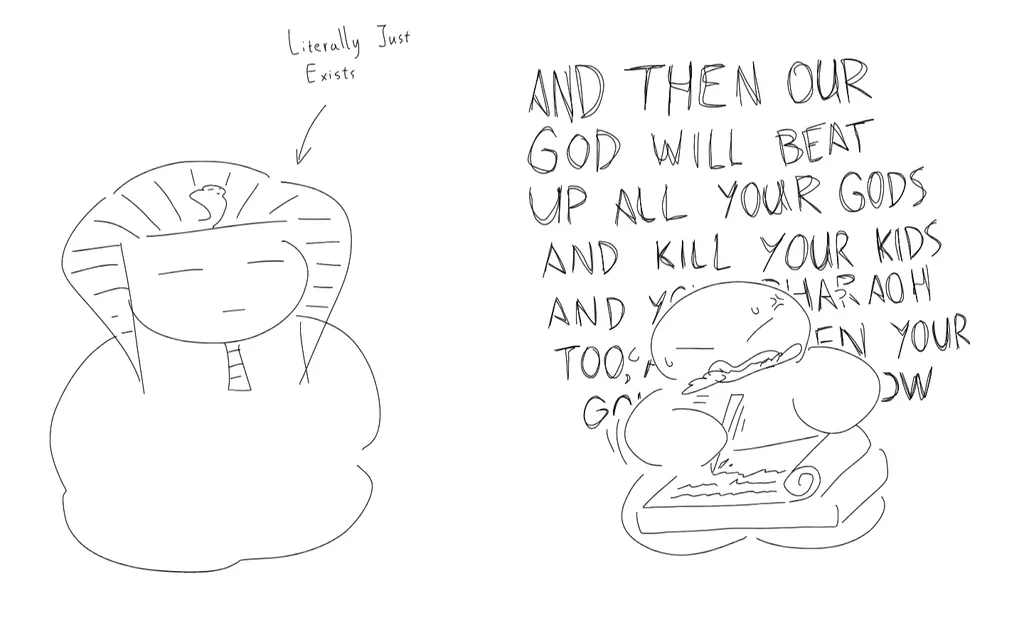
And then they continue to believe that it’s true to this day and thus it’s okay to genocide people and seize land because the god they made up promised the land they wanted to them.
The worse is that this story was written not to be taken literally. I mean, the pharaoh’s name is “Pharaoh”… it’s clearly a tale, and was from the beginning.
tbf, referring to divine monarchs only by their title is not uncommon. Many Egyptian texts referencing the Pharaoh of a given period only refer to him as ‘Pharaoh’. Hell, the Japanese Emperor traditionally does not go by any name until after he is deceased.
Even many texts written outside of a Roman cultural milieu refer to the Emperor only as ‘Caesar’ without mentioning the Emperor’s actual name.
Yes, but this text was not written in Egypt. In Israel and Judah, were the tale was written, the king is always named, between other causes because the principle of the divine monarchy is heavily criticized. But there are other problems with names, like the name of the parted sea (the Yam Suph is not the Red Sea), which would clearly put the story in a fantastical setting for a subject of Israel and Judah. And the structures and events are topos of ancient near east mythology (the reluctant leader, for example). Ancient people did not believed in their myths in the modern sense of the word, as Paul Veyne proved with the Greeks. It was the same for the Hebrews.
The New Testament only refers to the reigning Emperor as Caesar - is this because the notion of a divine monarchy is now accepted in Jewish-Christian culture of the 1st century AD?
Aren’t there a number of actual locations that are regarded as fitting the Yam Suph?
I feel like that’s a dangerous level of cross-cultural equivocation, especially considering the vast differences in both philosophical and religious attitudes between the two peoples. You never see Temple or Rabbinical Judaism, for example, discussing the possibility of changing the founding mythology of their faith the way that Greeks openly did.
No, there is at least two named emperors, August (Luke 2:1) and Tiberius (Luke 3:1). Most of the usages of Caesar in the New Testament is about the function, not an Emperor in particular.
Quite a few, but none is clear. It’s not a particular location, not one knew by the people of the time.
No, but we see the result of these changes. Just look at Genesis 1 and Genesis 2; the first one clearly is a rewriting of the second. Or both books of Chronicles, which are rewritings of the books ot the Kings.
You’re right about that, I concede that point. It’s been a long time since I’ve read the New Testament.
Do you think most provincials and Hellenized citizens of the East would have made that distinction clearly?
How can it be asserted to not be a particular location if there are several possible locations that fit?
We don’t know where the Rubicon River was, yet it’s certain that it was a particular location.
Results are very different from proposals. I can remake all the myths I want simply by retelling them in the way that I desire without further comment; but proposing to do so can lead to very different reactions according to culture and context. Proposing to rewrite a myth necessitates either supremacy of human needs or perceptions over the myth - something which was controversial but not unthinkable for Greeks, but near-unthinkable for Judaism and subsequent Abrahamic religions.
The distinction between a function and someone occupying it is not one hard to make.
Because when authors wanted to be precise, they can. If they don’t, it’s a choice. Millenia after, religious archeologists who read this text literally looked for the place, and the fact that they did not found one and disagree is more telling than anything else.
The fact that they did not keep tracks of their discussions doesn’t mean they did not occur. And the extent of the biblical rewriting, with discernable schools like the deuteronomist one, is the proof that this rewriting was conscious, organized and debated. We also have signs of this kind of work in Qumran. You seem to see Judaism as an ahistorical reality; the truth is that it evolved a lot; rewriting propositions were common until at least the fall of Jerusalem in 71. And after that, this work continued differently in the Midrashim, without changing the text but changing its interpretation extensively, with comparable results as the rewriting of the text.
That’s a very fucking modernist point of view.
what.
Do you… do you think they were going to give a coordinate grid reference if they wanted to be precise?
Do you have any idea how many place names are incredibly generic, and only have any manner of uniqueness because of the adoption of the practice of not translating foreign toponyms? Itself a very recent development in most languages?
They gave the name of what they called the place. How much more precision are you looking for?
… you literally already conceded that there are several places that fit the description by archeologists’ estimates.
“You can’t prove that they didn’t” isn’t very fucking compelling from an academic standpoint, especially when the argument presupposes the existence of the discussions to begin with.
How does that follow at all?
… what is that even supposed to mean?
…
Changing interpretations and changing the text are so fucking distant from each other in an Abrahamic religious context that it’s bizarre that you even bring it up.
Thank you for the reference to Paul Veyne. I’ve been reading quite a lot of history, most recently a summary of Egyptian history and I might have to skim Veynes work.
Veyne is great. I don’t know how his work is treated by nowadays historians, but it was a revelation for me. My passion is more medieval history, but we find the same kind of things: just read medieval bestiaries, you’ll find a lot of unbelievable things about very common animals like rabbits. People who wrote that knew that they were not real things, but they still thought that they were true. We lost a lot when we begun to think that real = true. It was the same things for mythologies, and biblical ones too: people knew they weren’t real things of the past, but they were true things of their present.
It’s more complicated than that of course (there are more than just two “modes of truth” to use Veyne’s terminology), and I’m sure most people believed that Moses actually existed (he probably didn’t). Moreover, an intellectual and a peasant probably didn’t judge these things in the same way. But the fact that truth ≠ reality for most people before the Enlightenment (and in fact, it’s still true today but in a hidden way) helps understand a lot of historical texts.
I haven’t read the book, but that seems a very curious assertion given the widespread expressed beliefs of medieval societies with regards to the fantastic creatures they recorded which would be very difficult to reconcile with the notion that their belief was purely a metaphorical truth.
No Veyne spoke only about Greek mythology. The part about bestiaries is influenced by an other historian, Michel Pastoureau.
Not purely metaphorical. The strict opposition between metaphor and real stories is modern.
That sounds like a leap to separate metaphor and the notion of an intrinsic natural order.