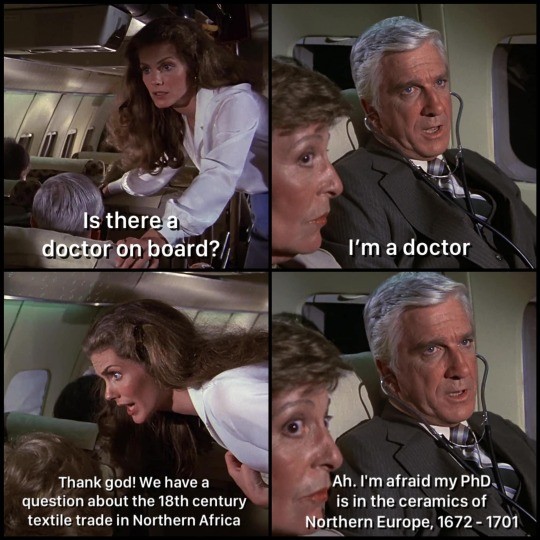

I’ve started answering all those questions as if asked by a curious child.
“That’s a good question, let’s go find out together!”
Unlike the child, most adults hate that reply.
deleted by creator
Elaine should have asked for a physician. Doctors (people with advanced learning) came first. Doctors (physicians) kind of took over the term.
Physicians came second, altogether…
Depends whether you’re talking about the theatrical release or the special edition.
My friends when they ask me about anything in the eastern hemisphere lol
Must have been some tumoultous 29 years for ceramics in Northern Europe.
PhDs are always that precise given the nature of how the levels of academics work.
A bachelors degree involves a lot of general education even though you also do choose a major as a kind of specialization. Having a bachelors degree does imply some increased level of overall knowledge. This leads people to assume that the same is true for even higher education, but it isnt.
A masters degree is virtually entirely specialized, although still referred to in some general terms like majors are. But ultimately ones thesis and specific aims within their field of study define what their masters really is about.
A PhD is primarily a continuation of that focus and expertise that was established in a masters thesis program. So there are only PhDs in extremely specific concepts. Even though we might call someone a doctor of sociology or history or whatever, they really only have doctorate expertise in something hyperspecific
It doesnt help the confusion that medical doctors are effectively the opposite, as a medical doctorate requires a ton of knowledge across a wide number of fields, although they can then further specialize just as much